
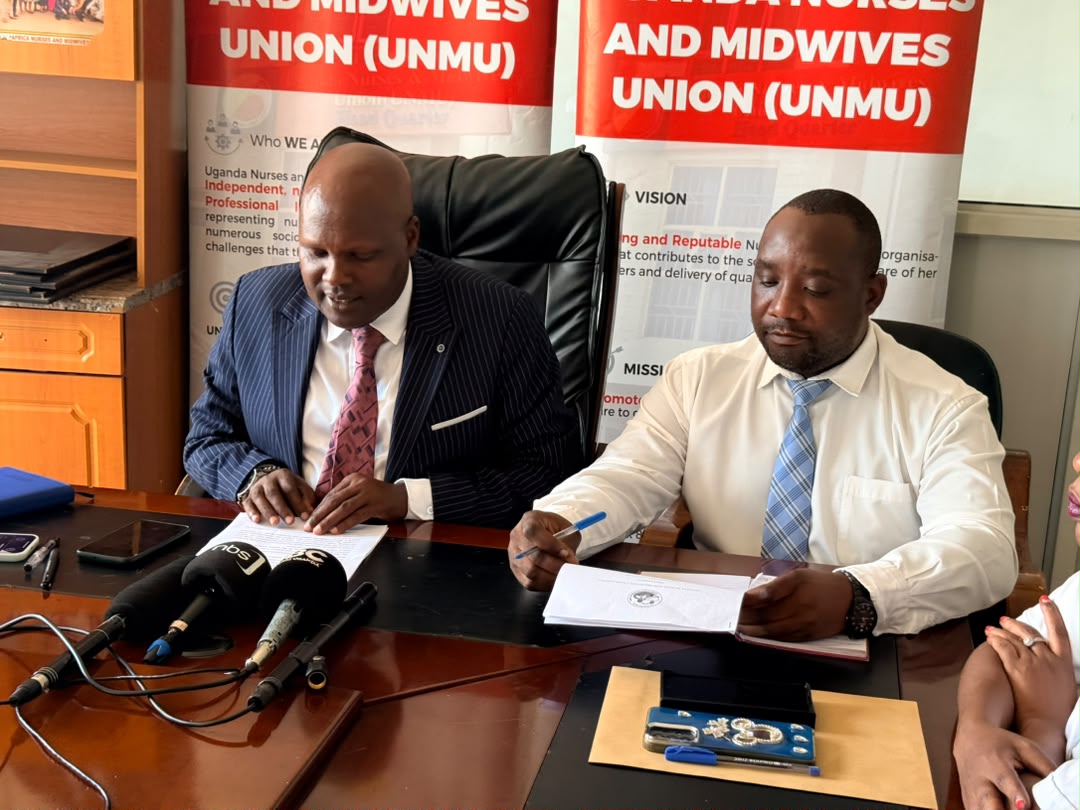
The Uganda Nurses and Midwives Union (UNMU) has scriticised the government’s reported decision to remove allowances for medical interns, warning that the move could undermine patient safety, worsen health worker shortages, and accelerate the migration of trained medical personnel from Uganda.
Addressing journalists at the union’s offices onin Kampala UNMU President Justus Cherop Kiplangat said the decision contradicts provisions of the National Education and Training for Health Policy 2025, which identifies poor welfare among interns as one of the major challenges affecting the quality of health training.
“Removing allowances for medical interns does not improve welfare. In any case, it worsens it,” Kiplangat said. “Hungry, stressed medical interns cannot provide safe care.”
The union’s intervention comes amid growing concern within the health sector over the fate of medical interns, who undergo mandatory supervised training in hospitals before qualifying for full professional registration.
Kiplangat argued that the government’s own policy framework acknowledges that inadequate welfare for interns and supervisors has contributed to deficiencies in internship training.
He said the policy explicitly states that poor welfare and increasing numbers of interns have affected the quality of internship programmes, making the removal of allowances inconsistent with the government’s stated objectives.
“The government is contradicting its own policy,” he said. “You cannot claim to strengthen health training while at the same time removing support for the people undergoing that training.”
UNMU also challenged the notion that interns should work without financial support, noting that the policy defines internship as supervised hands-on training lasting at least one year.
According to the union, medical interns perform clinical duties under the supervision of senior health professionals and therefore contribute directly to patient care.
“If it is work, it must be paid,” Kiplangat said. “Unpaid work is exploitation. It should not be acceptable for medical interns to be deployed to health facilities and expected to work without any form of payment.”
The union further warned that the decision could worsen the country’s health workforce crisis by encouraging more medical professionals to seek opportunities abroad.
Citing figures contained in the National Education and Training for Health Policy 2025, Kiplangat said about 10 per cent of doctors migrate annually due to inadequate wages and job insecurity.
“There is no way you will transform Uganda’s health workforce by starving them,” he said. “Removing intern pay will only accelerate brain drain.”
The warning comes as Uganda continues to grapple with shortages of health workers in many public health facilities, particularly in rural areas where staffing gaps remain a major challenge.
UNMU also framed the issue as a patient safety concern, arguing that interns struggling to meet basic living costs could be more prone to errors while handling patients.
The union cited the policy’s guiding principle that places public interest and patient safety at the centre of all health education and clinical training arrangements.
“An intern working without food or transport money is a patient safety hazard,” Kiplangat said. “Mistakes made by hungry personnel will cost Ugandan lives.”
The nurses’ and midwives’ body demanded the immediate reinstatement of medical intern allowances and called on government to honour commitments contained in the health training policy.
Among its demands, the union wants government to reverse the reported policy change, strengthen internship programmes through improved welfare, and engage health workers through consultations before implementing reforms affecting the sector.
“Dialogue, not imposition, should guide decisions that affect the health workforce,” Kiplangat said.
UNMU also invoked remarks contained in the foreword of the National Education and Training for Health Policy 2025 by First Lady and Education Minister Janet Museveni, which emphasise the need for a competent, motivated and productive health workforce to strengthen Uganda’s health system.
According to the union, removing allowances for interns undermines those objectives and risks weakening the country’s ambitions to become a regional centre for quality healthcare under Vision 2040.
The union declared its solidarity with medical interns and urged government to reconsider the decision before it triggers wider consequences for healthcare delivery.
“A hungry medical intern is a danger to the patient on the bed,” Kiplangat said.
UNMU called upon Ugandans and stakeholders in the health sector to support efforts aimed at restoring intern allowances, arguing that investing in the welfare of trainees is essential for maintaining standards of healthcare and protecting patients across the country.
The government had not yet responded to the union’s concerns by press time.
